Steel Automated Micro-Fulfillment Center: AGV Slabs & Robotic Steel
Steel Automated Micro-Fulfillment Center: AGV Slabs & Robotic Steel

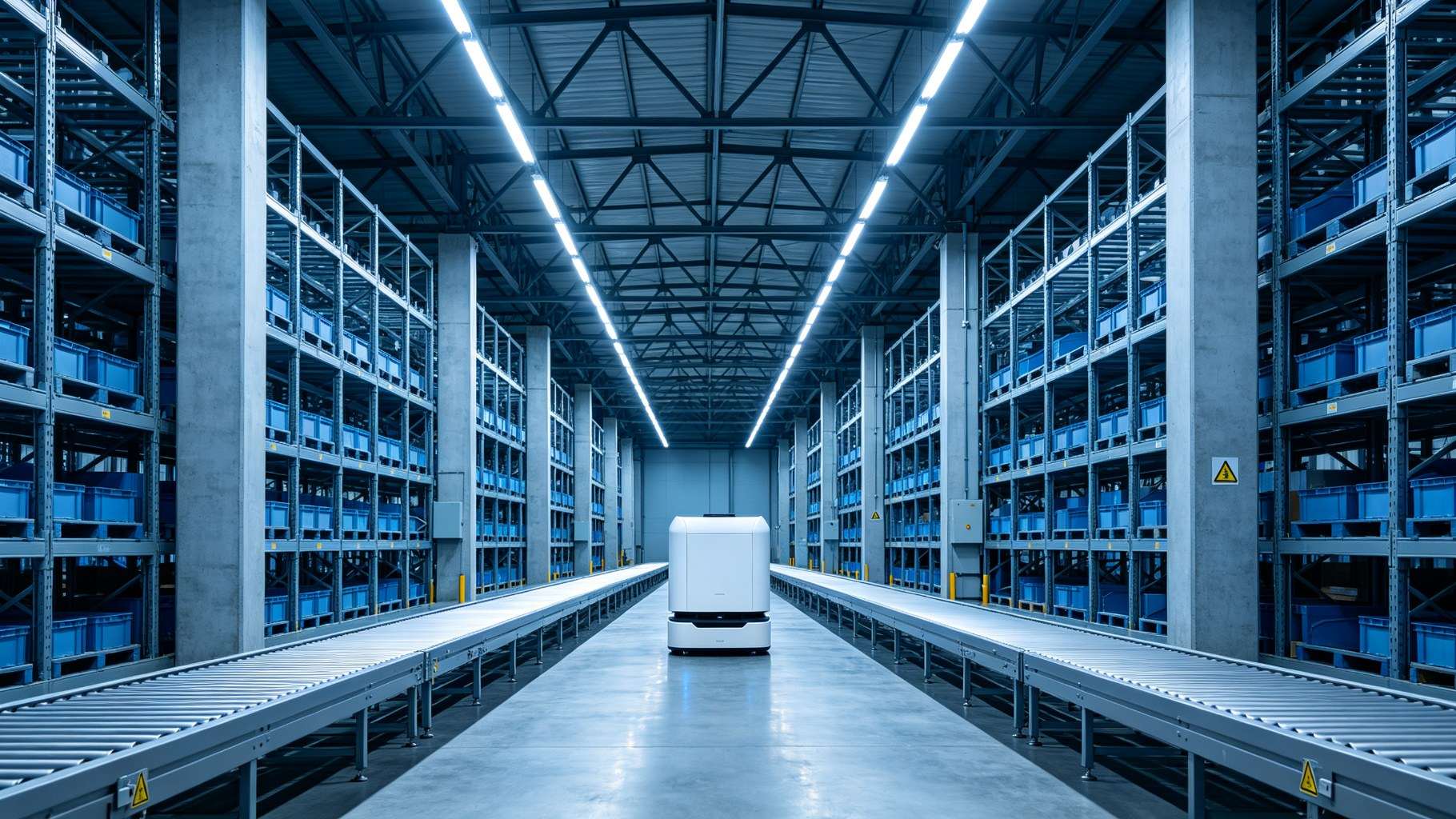
Interior view of an MFC: multi-level steel mezzanines carry dense yellow racking, AGVs glide across green epoxy slab, silver conveyors climb columns, and a robotic sorting station glows under LED high-bays.
A traditional warehouse stacks pallets, drives forklifts down aisles, and picks orders by hand. A micro-fulfillment center packs robots, conveyors, and high-density racks into a fraction of the space—often a mezzanine or basement—where a 3 mm floor bump can stop an AGV and a rack sway of 25 mm can trigger a robotic error. A steel automated micro fulfillment center is engineered around three demands: ultra-flat AGV floors (FF 35+), seismic-rated high-bay rack structures, and vibration-isolated robotic mezzanine levels. This guide covers the structural differences versus e-commerce warehouses, AGV slabs and point loads, high-bay rack bracing, robotic mezzanines, vibration control, and cost phasing. Start with steel cross border ecommerce warehouse for the manual-picking baseline.
Why Steel Fits a Micro-Fulfillment Center
A steel automated micro fulfillment center is not a smaller warehouse. Our warehouse article describes forklifts, 3–5 m (10–16 ft) selective racks, and ordinary FF 20 floors. An MFC uses AGV/AMR navigation, 8–15 m (26–49 ft) high-bay racks, robotic sorting, and floors that must meet FF 35 / FL 25. Steel is the natural frame because light mezzanines can stack two to three levels of automated storage without overloading an urban infill building.
Typical MFCs run 930–3,700 m² (10,000–40,000 sq ft) inside a city delivery node. Column spacing of 9–12 m (30–40 ft) leaves 1.5–2 m (5–6.5 ft) AGV aisles clear. Eave heights run 7–12 m (23–39 ft), with 2–3 mezzanine levels. Zones split into receiving, automated storage, sortation, packing, and shipping. Adjacent references include steel logistics distribution center and steel building floor system.
The urban infill context changes the brief. This automated fulfillment facility often sits in an existing warehouse basement, a dead retail box, or a building added on to a last-mile depot. That means the frame must be light enough to sit on an existing slab or add a mezzanine without overloading it, and compact enough to fit a dense rack footprint. Ceiling clear height is the single most expensive constraint: every extra meter of mezzanine vertical space buys roughly 8–12% more storage density. Mechanical and electrical penthouses squeeze into leftover roof space, so roof live loads for HVAC and sprinkler manifolds must be reserved at steel design.
AGV Floors, Flatness Tolerance & Point Loads
AGVs navigate to ±5–10 mm. That tolerance drives floor flatness: per ACI 302.1, MFC slabs need FF 35 / FL 25—roughly three times flatter than a standard warehouse. Floor slope stays under 1/500, and local variation must not exceed 3 mm over 3 m. Slab thickness should be at least 200 mm (8 in) with welded-wire reinforcement and a diamond-hardened or densified wearing surface.
Each AGV or AMR weighs 500–1,500 kg (1,100–3,300 lb) loaded, with concentrated wheel pressures that drive slab thickness. Storage mezzanines carry 12–20 kN/m² (250–420 psf), and rack base plates apply 20–40 kN (4,500–9,000 lb) of point load per column. Deflection and foundation sizing follow steel structure deflection control and steel building foundation.
| AGV Type | Weight (kg / lb) | Floor Load (kN/m² / psf) | Flatness (FF / FL) | Notes |
|---|---|---|---|---|
| AMR tote transporter | 500–800 / 1,100–1,760 | 12–15 / 250–310 | FF 35 / FL 25 | Laser guidance |
| Pallet AGV | 1,000–1,500 / 2,200–3,300 | 15–20 / 310–420 | FF 40 / FL 30 | Heavier wheel loads |
| Sortation robot cell | 800–1,200 / 1,760–2,640 | 12–18 / 250–376 | FF 35 / FL 25 | Includes arm base |
| Conveyor line | — | 5–8 / 100–170 | FF 25 / FL 20 | Continuous, less strict |
High-Bay Rack Loads & Seismic Bracing
High-bay racks in a steel automated micro fulfillment center run 8–15 m (26–49 ft) tall and carry 20–30 kN/m² (420–630 psf) uniformly. Racks are cantilever structures, so seismic overturning moments are large; base plate anchors must transfer tension and shear into the floor slab. Racks can be connected to the building structure or separated with their own bracing, but the load path must be explicit. Top-of-rack lateral ties to roof beams prevent out-of-plane toppling.
Racks design to RMI/ANSI MH16.1, with seismic coefficients per ASCE 7. P-Δ effects must be checked in high-seismic zones because slenderness is high. Seismic detailing references include steel building seismic design, steel structure seismic design deep dive, and steel building bracing system.
| Rack Height (m / ft) | Load (kN/m² / psf) | Seismic Zone | Base Connection | Notes |
|---|---|---|---|---|
| 8–10 / 26–33 | 20–22 / 420–460 | Low–moderate | Anchor bolts, base plate | 2 levels mezzanine |
| 10–12 / 33–39 | 22–26 / 460–540 | Moderate | Anchored + top tie | Check P-Δ |
| 12–15 / 39–49 | 26–30 / 540–630 | High | Anchored + top tie + bracing | Full seismic check |
| Shuttle rack system | 25–30 / 520–630 | Any | Continuous lateral tie | Dense storage |
Building a Micro-Fulfillment Center Where AGVs Never Bump and Racks Never Sway?
We spec AGV floors to FF 35, anchor high-bay racks to ASCE 7 seismic loads, and design mezzanine beams that hold robotic sorting equipment without vibration. Tell us your daily order volume and robot mix.
Robotic Mezzanine & Goods-to-Person Systems
Most MFCs use two- or three-level steel mezzanines: ground floor for receiving and shipping, upper floors for automated storage. Mezzanine live loads run 12–15 kN/m² (250–310 psf), and beam deflection is limited to L/480 to keep rack and conveyor alignments true. Goods-to-person (G2P) workstations weigh 3,000–5,000 kg (6,600–11,000 lb) each and sit on isolated pads. Conveyor lines penetrate mezzanine slabs; every opening needs stiffened edge beams so the slab does not crack.
Sortation walls and packing tables carry 5–8 kN/m² (100–170 psf). Expansion and second-floor logic follow steel building expansion second floor, and deflection criteria follow steel structure deflection control.
In practice, a steel automated micro fulfillment center runs its heaviest equipment load on the mezzanine, not the ground floor. AGVs drive on the slab; racks and robots live overhead. That inversion means the mezzanine beams are the critical structural element, and their long-term deflection and vibration response must be tuned to the robot vendor's spec, not a generic L/360 deflection limit. Coordinate the robot vendor's base plate loading and anchor bolt pattern with the steel fabricator before mezzanine beam sizing is finalized—retrofitting anchor holes into a mezzanine flange is slow and expensive.
| Equipment | Weight (kg / lb) | Floor Level | Vibration Limit | Notes |
|---|---|---|---|---|
| G2P workstation | 3,000–5,000 / 6,600–11,000 | Mezzanine 2–3 | ≤ 25 mm/s | Isolated pad |
| 6-axis robotic arm cell | 1,500–3,000 / 3,300–6,600 | Mezzanine 2 | ≤ 25 mm/s | Vision-guided |
| Sortation conveyor line | 800–1,500 / 1,760–3,300 | Multi-level | ≤ 50 mm/s | Edge-stiffened opening |
| Packing / pack station | 200–500 / 440–1,100 | Ground / mezz | ≤ 100 mm/s | Light live load |
Vibration Control for Robotic Systems
Robotic arms and vision systems are vibration-sensitive; floor velocity is typically limited to 25 mm/s. Conveyor starts and AGV emergency stops inject energy into the floor system, so isolation pads or elastic supports are often needed under heavy robot cells. Steel mezzanine natural frequencies must be tuned away from the 10–50 Hz operating range of typical robots.
Before handover, floor vibration testing—walking exciter or shaker—should prove the design. Field acceptance follows steel building site acceptance inspection; deeper theory is in steel structure vibration control and steel floor vibration serviceability.
Practical experience shows that the most common vibration failure is not robot vibration but conveyor-induced rhythmic motion. A 30 m (100 ft) sortation conveyor running at constant speed can excite a mezzanine at its natural frequency over hours of operation, even though a single AGV bump is harmless. Tune the mezzanine frequency away from the conveyor drive frequency as well as the robot frequency, and specify variable-frequency conveyor drives so the operating speed can be adjusted if resonance shows up during commissioning.
Cost Overview & Phasing
Steel frame alone for an MFC runs $350–550/m² ($33–$51/sq ft) FOB. An AGV-grade slab plus mezzanine kit pushes the package to $550–800/m² ($51–$74/sq ft). Turnkey structural scope—rack anchors, robot pads, conveyor openings—lands at $900–1,500/m² ($84–$139/sq ft). The automation equipment itself (AGVs, robots, conveyors) is a separate line.
Phasing is common: start with a manual warehouse, move to semi-automation, then retrofit into a full MFC. Reserve electrical and conveyor interface points at steel stage. Cold-chain variants overlap with steel cold chain distribution center; general logistics context is in steel logistics distribution center.
One last practical note: the MFC is only as good as its commissioning sequence. AGV software, rack inventory, and robot cell logic cannot be tuned until the building is watertight, the slab has cured and been ground to final flatness, and the mezzanine vibration survey is signed off. Building the shell early enough to allow a 60–90 day commissioning window is the single biggest risk to opening on time. Overbuild the steel frame slightly to accommodate late-stage sensor mounts and cable trays—these always get added, and drilling them through a finished mezzanine flange is far more disruptive than embedding them at fabrication.
Frequently Asked Questions
Q1: What floor flatness does an AGV fulfillment center need?
AGVs navigate with ±5–10 mm precision, so floors must meet FF 35 / FL 25 per ACI 302.1—roughly 3× flatter than a standard warehouse. Local variation must not exceed 3 mm over 3 m, and floor thickness should be ≥ 200 mm (8 in) with diamond-hardened topping.
Q2: How much load does a high-bay rack impose on the floor?
High-bay racks at 8–15 m (26–49 ft) height carry 20–30 kN/m² (420–630 psf) uniformly, with concentrated base plate loads of 20–40 kN (4,500–9,000 lb) per column. In seismic zones, racks must be anchored and designed to ANSI MH16.1 with P-Δ effects checked.
Q3: Does an automated fulfillment center need vibration control?
Yes. Robotic arms and vision systems typically require floor velocity ≤ 25 mm/s. Steel mezzanines must be tuned so natural frequencies avoid the 10–50 Hz robot operating range. Floor vibration testing (walking exciter or shaker) should be part of site acceptance.
Q4: How much does a steel micro-fulfillment center cost?
Steel frame alone runs $350–550/m² ($33–$51/sq ft) FOB; a kit with AGV-grade slab and mezzanine is $550–800/m² ($51–$74/sq ft); turnkey (rack anchors, robot pads, conveyor openings) lands at $900–1,500/m² ($84–$139/sq ft). The automation equipment is additional.
Q5: Can a manual warehouse be converted into an MFC later?
Yes, but only if the steel frame reserves AGV-grade slab capacity, mezzanine interfaces, and seismic rack anchor points at design stage. Floor flatness in particular cannot be economically corrected after the slab is poured—freeze FF 35 before concrete is placed.
Case Example
An urban last-mile micro-fulfillment center shows how flat floors and tuned mezzanines decide the build. The facility occupied about 2,200 m² (24,000 sq ft) in a dense North American city, with two mezzanine levels, 10 m (33 ft) eaves, and racks reaching 12 m (40 ft). AGVs needed FF 35 navigation, high-bay racks needed seismic anchors, and the sortation conveyor threatened to excite the mezzanine. We specified a 220 mm (8.5 in) FF 35 slab, top-tied racks to ASCE 7 loads, and tuned the mezzanine natural frequency away from the conveyor drive. At acceptance the floor measured FF 38, forty-two AGVs ran without bump incidents, and robot-cell vibration held at 18 mm/s against a 25 mm/s limit; go-live took nine months. The manual-picking baseline is in steel cross border ecommerce warehouse; vibration serviceability is in steel floor vibration serviceability.
Conclusion
A steel automated micro fulfillment center is three structural problems stacked together: AGV floors to FF 35, seismic-rated high-bay racks anchored to ASCE 7, and vibration-isolated mezzanines tuned away from robot frequencies. Freeze AGV slab flatness before concrete is poured, and specify seismic rack connections that cannot be retrofitted later.
AGV Flat Floors, Seismic-Rated Racks, Vibration-Isolated Robots—One Steel Frame Does All Three.
We design micro-fulfillment centers level by level: AGV floors to FF 35, high-bay racks anchored to ASCE 7, and mezzanine beams tuned away from robot frequencies. Tell us your daily order volume and robot mix.
🏭 Explore: Steel Warehouse · Steel Workshop
Reference Links
- MHI—Material Handling Industry / ANSI MH16.1 Rack Standards — design and seismic standards for industrial steel storage racks.
- ASCE 7 Minimum Design Loads and Associated Criteria for Buildings — wind, seismic, and live-load basis used for rack and mezzanine design.
About the Author
Senior Structural Engineer
With over 20 years of hands-on experience in steel structure design and prefabricated building engineering, our in-house senior structural engineer has personally contributed to more than 500 steel building projects—including warehouses, industrial factories, aircraft hangars, agricultural buildings, and commercial structures. The focus is on translating design codes such as AISC 360, ASCE 7, and Eurocode 3 into buildable, cost-effective steel solutions that balance structural performance, fabrication efficiency, and total project cost.
Steel Lateral Torsional Buckling Design: Mcr, Lb & Bracing
Steel Anaerobic Digestion Biogas Plant: Digester Tanks & Gas Holders